
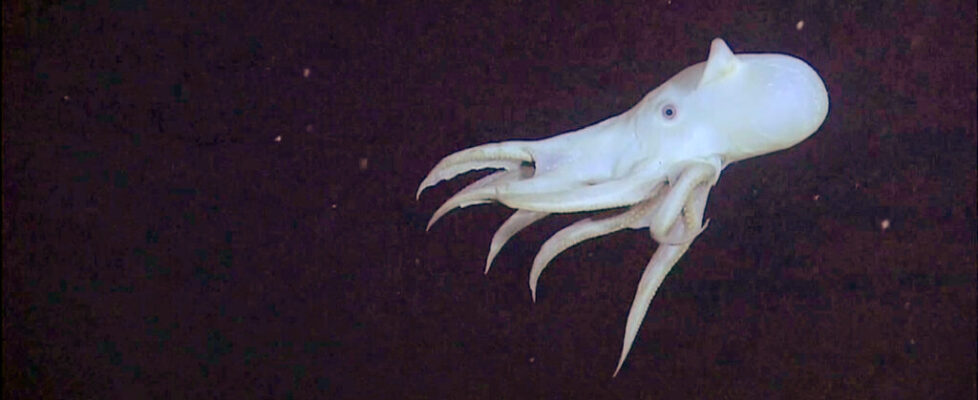
10 Deep-Sea Creatures That Look Like Aliens

Sunlight fades fast in the ocean. By about 200 meters down, there isn’t enough of it to power photosynthesis, and by roughly 1,000 meters it’s gone entirely. Together, these dim and dark waters make up the largest habitat on Earth: cold, crushingly pressurized and mostly lightless. The animals that live there have had millions of years to adapt, and the results look less like evolution and more like concept art for a sci-fi movie.
These 10 deep-sea creatures that look like aliens are all real, and most have been filmed alive only in the last few decades. You’ll meet transparent heads, slingshot jaws, glowing fishing rods and one fish that became famous mostly because it was having a terrible day.
10Blobfish
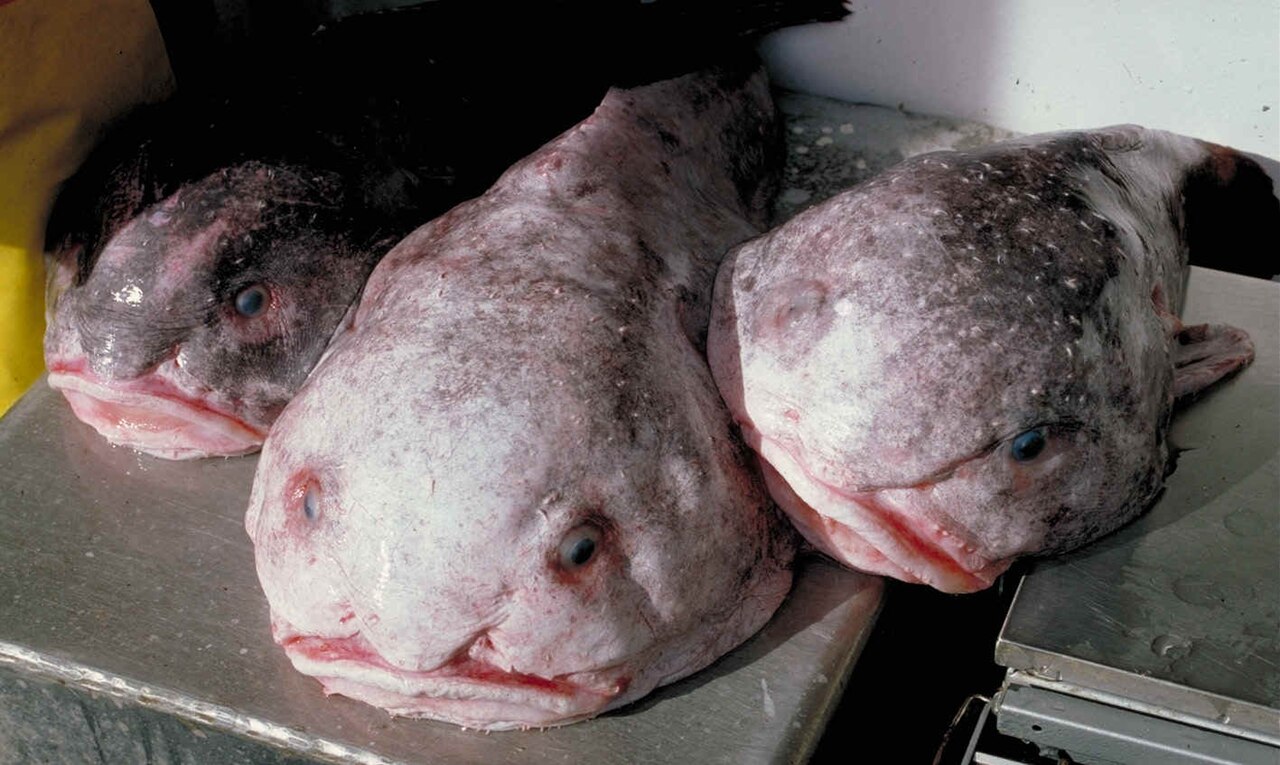
The world’s most famous ugly face is really a picture of an accident. That droopy, pink, frowning blob in the viral photo is what happens when a deep-sea fish gets hauled up from the depths too quickly. Blobfish live roughly 600 to 1,200 meters down off mainland Australia, Tasmania and New Zealand, where the pressure is 60 to 120 times greater than at sea level.
Down there, a blobfish looks like a fairly ordinary fish, with a tadpole-shaped body and a tapering tail. Its flesh is a gelatinous mass slightly less dense than water, which lets it hover above the seafloor without wasting energy on swimming. It has very little muscle and simply eats whatever drifts within reach, such as small crustaceans. Drag it to the surface, though, and the sudden drop in pressure ruptures its tissues. The body slumps into the saggy shape everyone recognizes.
The celebrity specimen, nicknamed Mr. Blobby, was caught in 2003 on the NORFANZ research expedition along the Norfolk Ridge, more than 1,000 meters down. Australian Museum ichthyologist Kerryn Parkinson took the photo. In 2013, a public vote run by the Ugly Animal Preservation Society crowned it the world’s ugliest animal. Mr. Blobby now rests in a jar of alcohol in the Australian Museum’s collection.
9Sea Pig
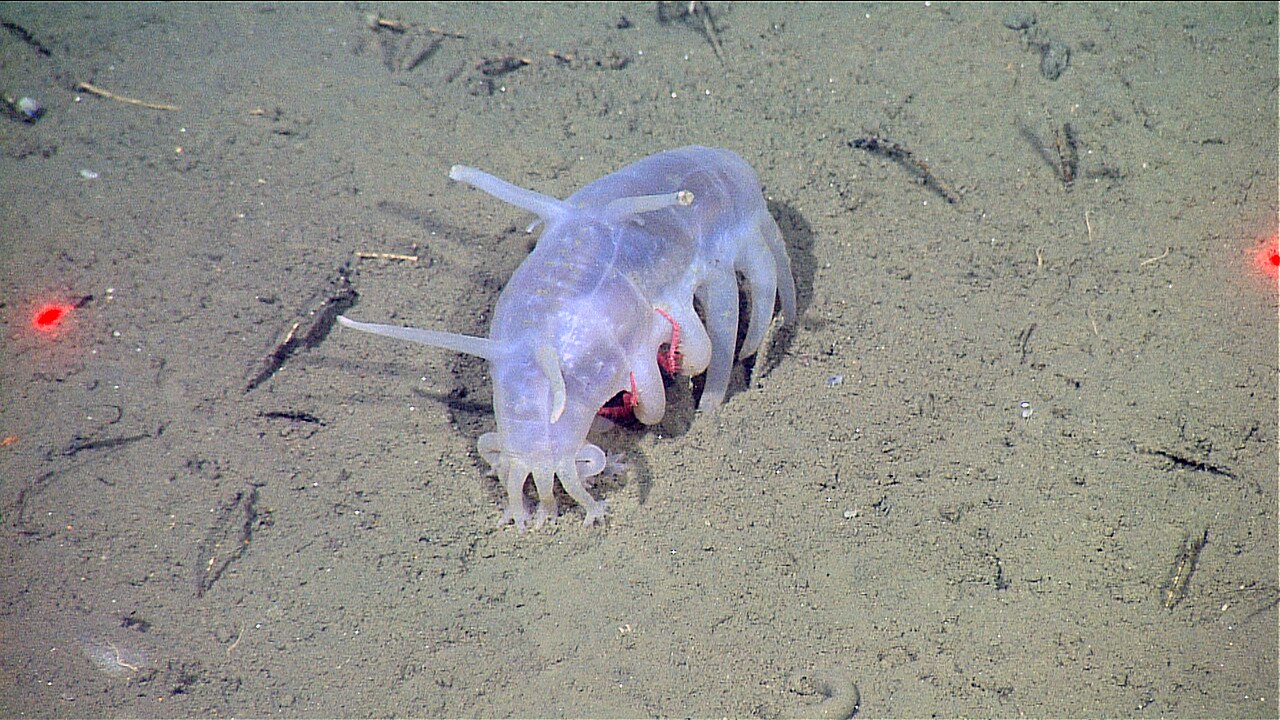
Picture a pink, see-through piglet with too many legs, trundling across the mud in a herd of several hundred. Meet Scotoplanes, the sea pig, a sea cucumber that lives on deep-sea plains, typically between about 1,200 and 5,000 meters down.
Those stubby “legs” are enlarged tube feet, hydraulic tubes that the animal inflates and deflates with water from its internal plumbing. Sea pigs walk on six pairs of them, and a few extra ones on top of the body stick up like antennae. They’re deposit feeders, vacuuming up the thin film of organic matter that rains down from the sunlit ocean above. Some species seem to follow their sense of smell to rich food sources such as whale falls, the carcasses of dead whales that sink to the seafloor.
Early collections recorded groups of 300 to 600 individuals, which suggests they crowd together wherever the food is best. They also make useful neighbors. Juvenile crabs of the species Neolithodes diomedeae have been seen sheltering beneath sea pigs, probably to avoid predators, and the sea pigs themselves host a small community of parasites and hitchhikers, including tiny snails and crustaceans.
8Giant Isopod
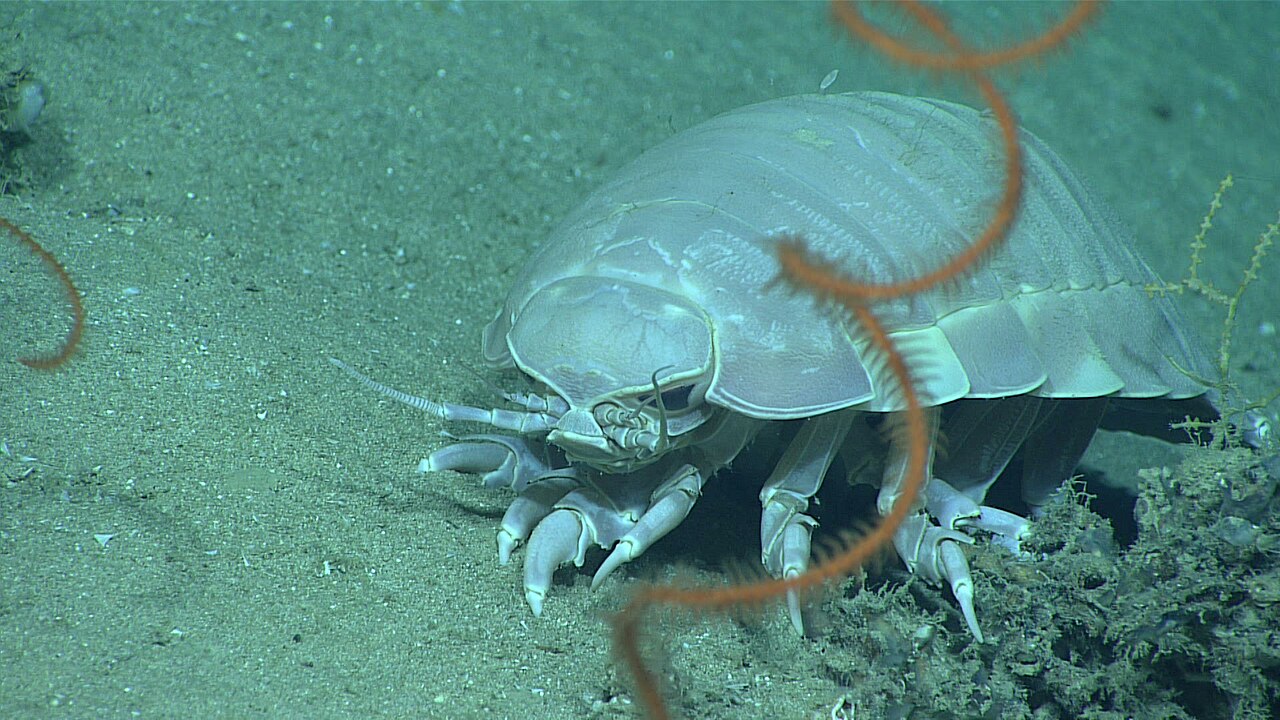
Think of the little pill bug under a garden rock, then scale it up to roughly the length of a house cat. Bathynomus giganteus belongs to the same order as woodlice, the isopods, and it’s one of the clearest examples of deep-sea gigantism, the tendency of some invertebrates in cold, deep water to grow larger and live longer than their shallow-water cousins.
French zoologist Alphonse Milne-Edwards described the species in 1879 from a specimen found in fishermen’s nets off the Dry Tortugas in the Gulf of Mexico. Most adults measure 19 to 36 centimeters, and the largest confirmed specimen was about 50 centimeters. Each compound eye has more than 4,000 individual facets, an impressive setup for an animal that lives 310 to 2,140 meters below the surface, where light is scarce or absent.
Giant isopods are scavengers, feeding on dead fish, whales and squid that sink to the bottom. Meals can be far apart, so they’re built to wait. One captive giant isopod at Japan’s Toba Aquarium refused food for more than five years before it died in 2014, baffling its keepers. New relatives keep turning up, too: in 2025, scientists named a supergiant species from Vietnam Bathynomus vaderi, because its head resembles Darth Vader’s helmet.
7Gulper Eel
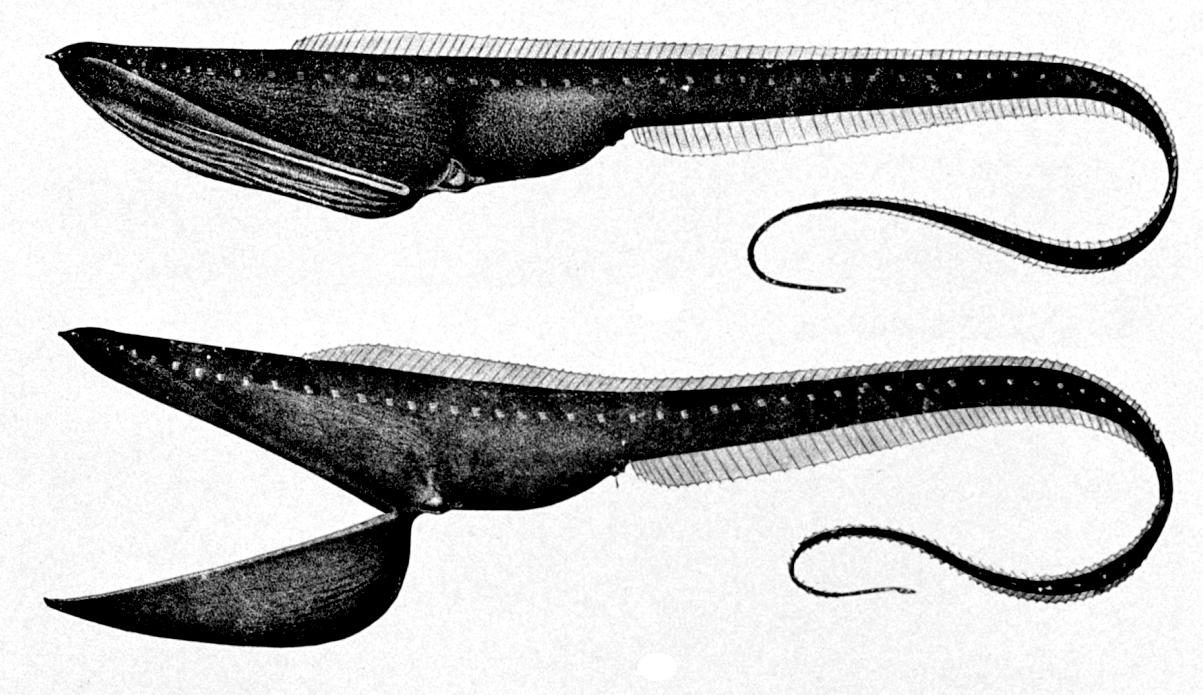
Most of a gulper eel is mouth, and the rest looks like an afterthought. Eurypharynx pelecanoides, also called the pelican eel, has a loosely hinged jaw estimated at about a quarter of its total length, attached to a thin, whip-like body that can stretch to around 75 centimeters. It drifts through the open ocean roughly 500 to 3,000 meters down.
You might expect a mouth like that to swallow big fish whole. Stomach analyses suggest otherwise: gulper eels mostly eat small crustaceans, along with some squid and other small invertebrates. Scientists think the huge mouth works like a net, scooping up a big gulp of water and prey and then pushing the water out. Its stomach can stretch to handle a larger meal when one comes along, which in the food-poor deep sea is a handy option to have.
In September 2018, the crew of the exploration vessel Nautilus filmed a juvenile gulper eel in the Papahānaumokuākea Marine National Monument, northwest of Hawaii. On the live stream, the eel inflated its mouth into a balloon-like sac, then deflated it, while the scientists watching reacted with audible disbelief. French zoologist Léon Vaillant described the species in 1882.
6Dumbo Octopus
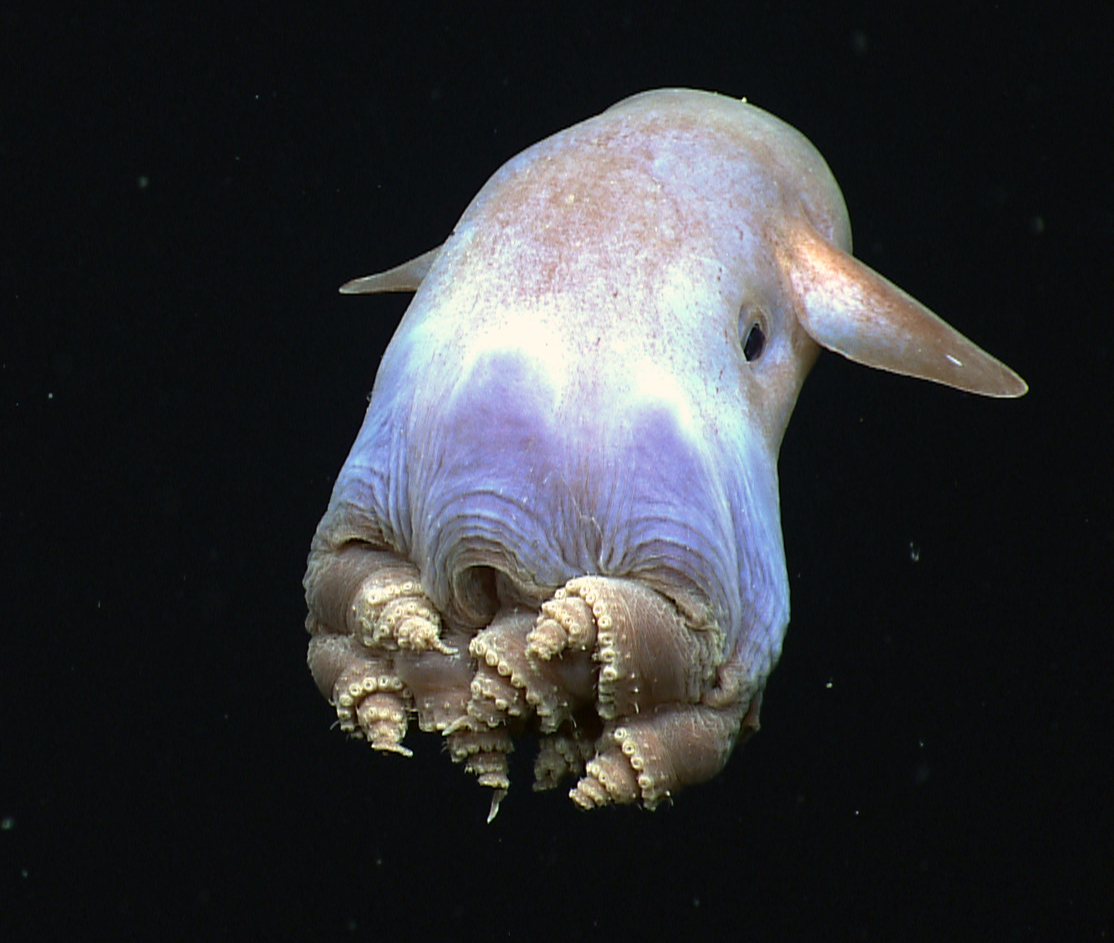
The deepest-living octopus known to science looks like it wandered out of a children’s cartoon. Octopuses in the genus Grimpoteuthis are nicknamed dumbo octopuses after the title character of Disney’s 1941 film, thanks to two ear-like fins sticking out from the mantle above each eye.
They usually live between about 1,000 and 7,000 meters down. In 2020, researchers published footage of a dumbo octopus filmed at 6,957 meters in the Java Trench in the Indian Ocean, a depth record for confirmed cephalopod sightings. Instead of jetting around like their shallow-water relatives, dumbos flap their fins to glide slowly above the seafloor, using their webbed arms like a skirt to steer and hover.
Nobody has watched one hunt, so scientists rely on stomach contents and close relatives for clues. Dissected dumbos have contained worms, copepods, amphipods and isopods, and they likely trap prey in their arm webbing, then use the finger-like cirri along their arms to push food toward the mouth. Their reproduction is equally low-key. Females attach eggs to deep-sea corals and leave, and the young hatch as fully capable miniature adults.
5Vampire Squid
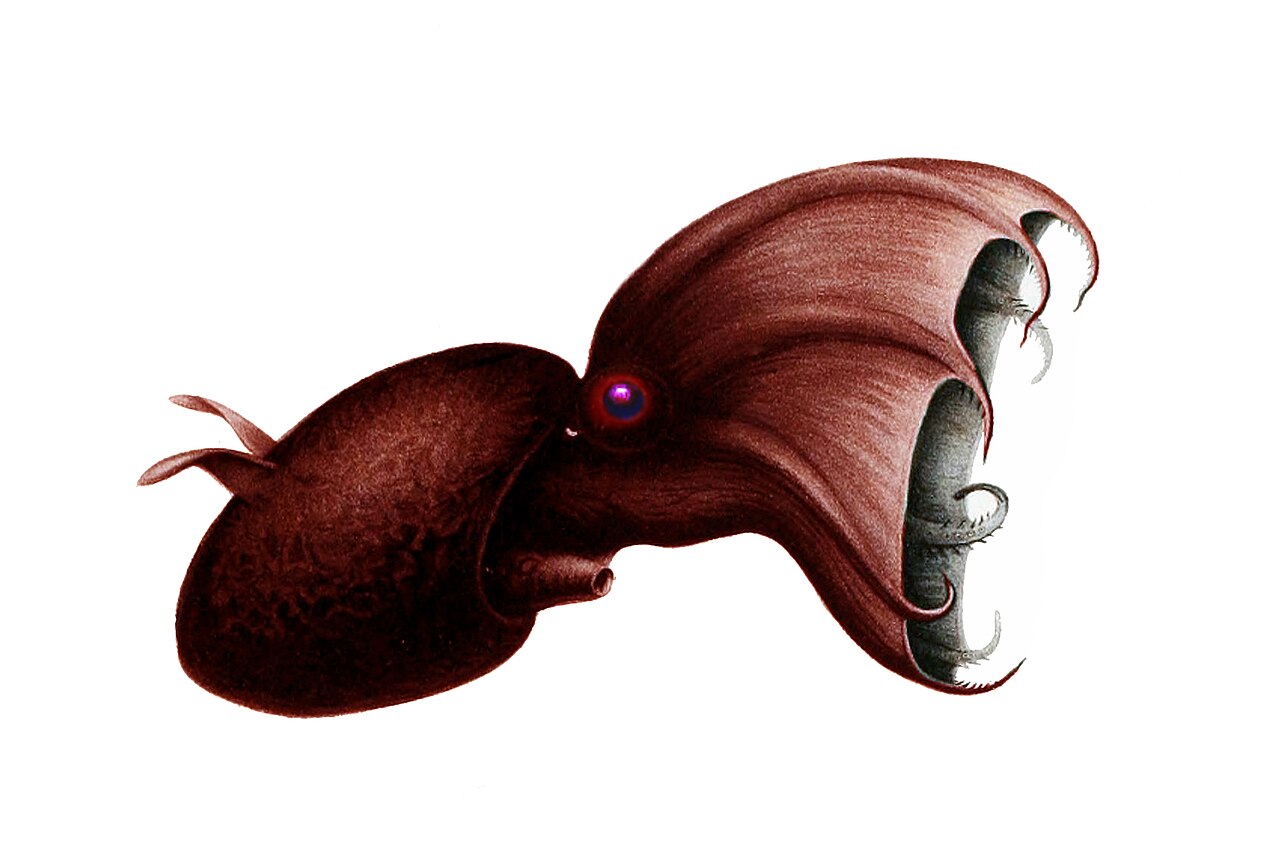
Its scientific name, Vampyroteuthis infernalis, translates roughly as “vampire squid from hell.” The real animal is a shy, slow-living scavenger that has never sucked anyone’s blood. It got the name from its dark, reddish skin, the cloak-like webbing between its arms and its eyes, which can look red or blue depending on the light.
It isn’t technically a squid, either. The vampire squid is the only surviving member of its own order, Vampyromorphida, and it’s more closely related to octopuses. German zoologist Carl Chun first described it in 1903, from specimens collected on the Valdivia expedition of 1898 to 1899, and he initially classified it as an octopus. It lives about 600 to 900 meters down in the oxygen minimum zone, where oxygen levels can fall as low as 3 percent of saturation. It’s the only cephalopod known to spend its whole life there.
In 2012, researchers at the Monterey Bay Aquarium Research Institute showed that it feeds on marine snow, the drifting flakes of dead plankton, waste and debris. It snags the particles with two long, retractable filaments and glues them together with mucus. When threatened, it flips its webbed arms over its body into a spiky “pineapple” posture or releases a cloud of glowing mucus instead of ink.
4Frilled Shark
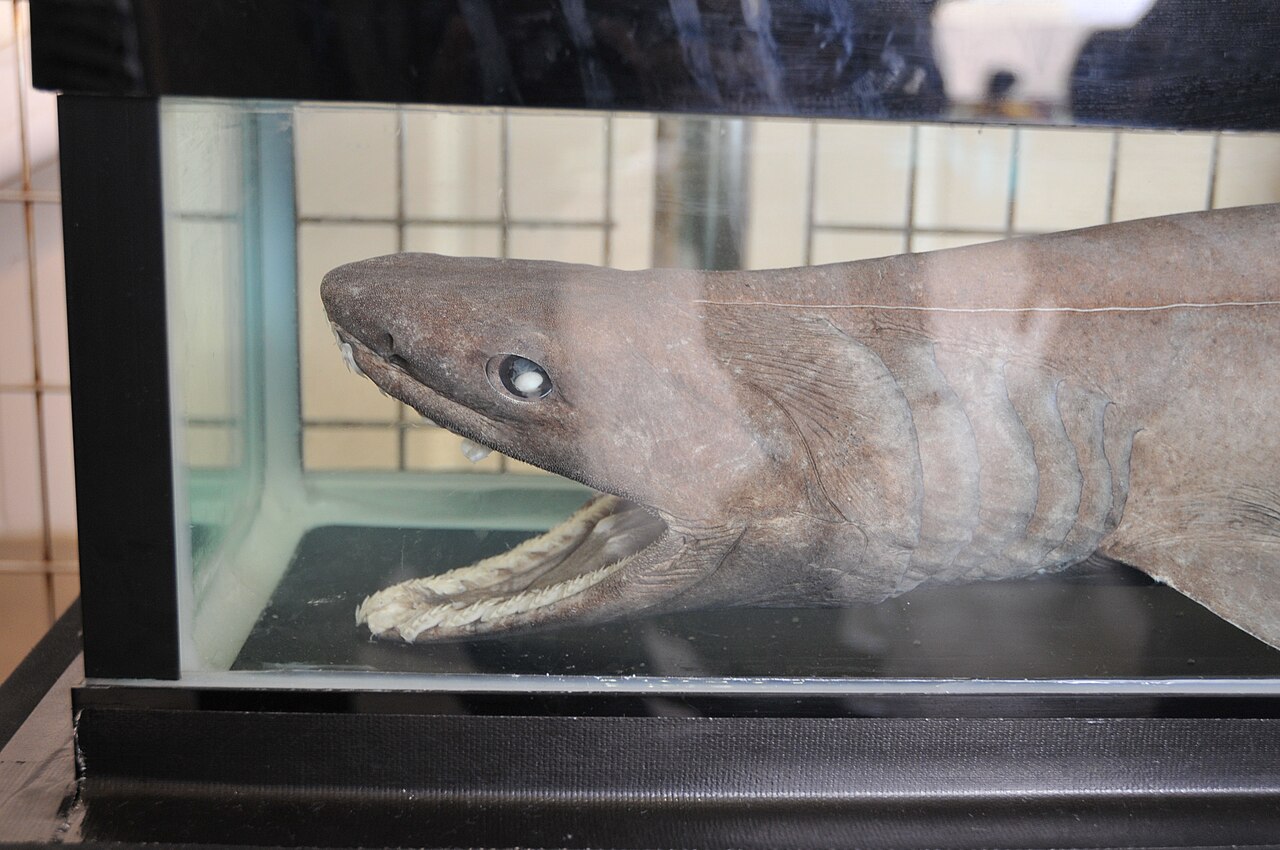
In 2007, a fisherman in Japan found a 1.6-meter shark with a snake-like body swimming near the surface. It was taken to Awashima Marine Park in Shizuoka, where it was filmed before dying a few hours later. The footage gave the world a rare look at a living frilled shark, a species usually hidden well below the sunlit zone.
The frilled shark looks like a sea serpent from an old map. Its long, brown body reaches about 2 meters in females, and the six pairs of gill slits have frilly edges, with the first pair meeting across the throat like a ruffled collar. Its jaws hold about 300 teeth arranged in rows, and each tooth has three needle-like points. That’s an ideal design for snagging slippery squid. Scientists think it may brace its body and fins to lunge forward in a sudden strike, like a snake.
The species is often called a living fossil. Its family lineage stretches back to the Carboniferous period, more than 300 million years ago, and its body plan resembles that of ancient sharks. Frilled sharks are rarely seen alive, and most of what’s known comes from animals caught accidentally by deep-water fishing boats off Japan and elsewhere.
3Barreleye Fish
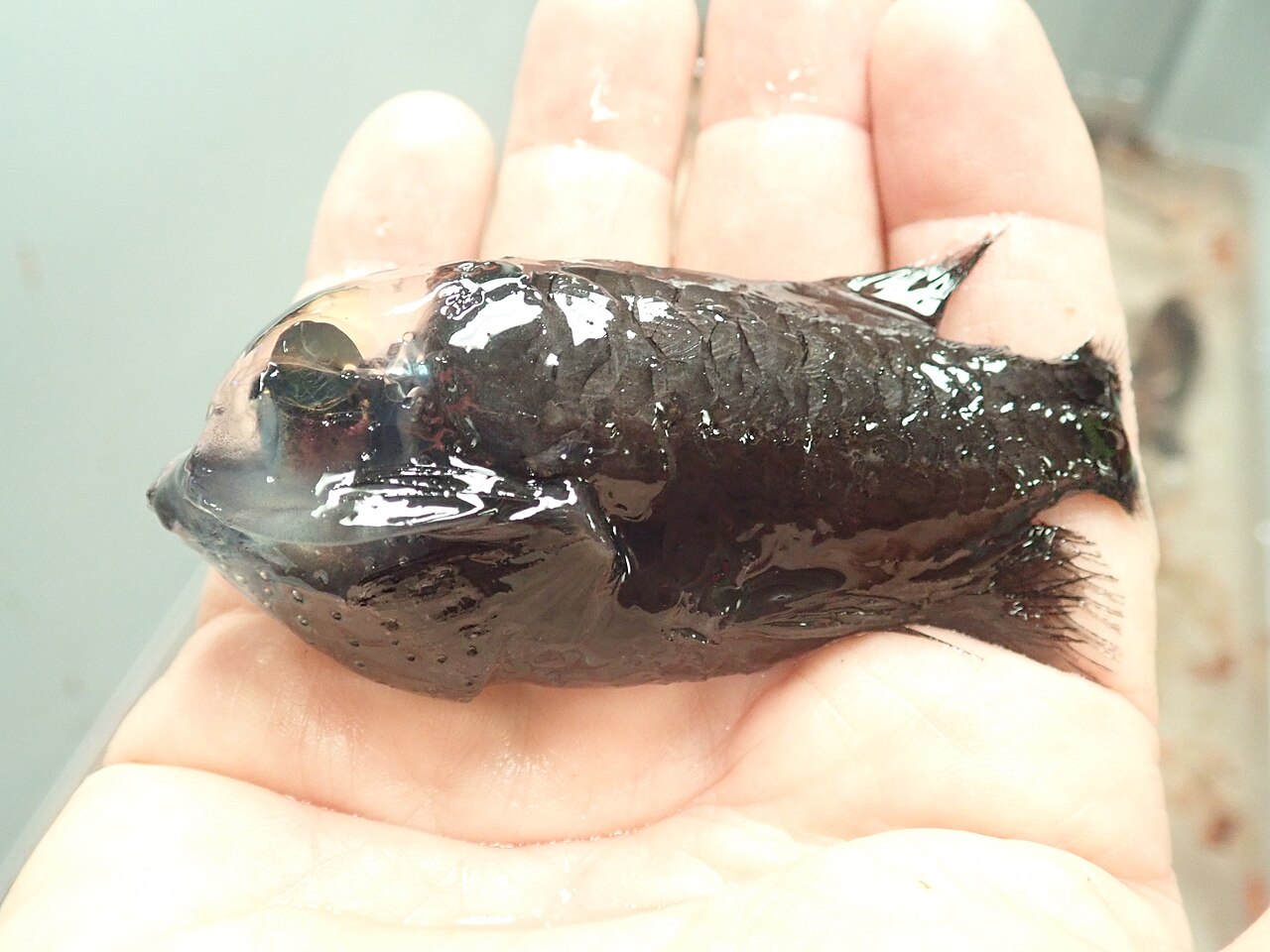
For decades, the scientists who studied the barreleye fish had no idea its head was see-through. Marine biologist W. M. Chapman described Macropinna microstoma in 1939, but specimens dragged up in nets arrived with their fragile, transparent heads destroyed. Nobody had seen the whole animal.
That changed when remotely operated vehicles from the Monterey Bay Aquarium Research Institute photographed living barreleyes off central California in 2004. Researchers Bruce Robison and Kim Reisenbichler finally saw the full picture: a clear, fluid-filled dome covering the top of the head, with two bright green, barrel-shaped eyes inside. In a paper published in 2008, they showed that the eyes can rotate within the shield. They point straight up to spot the silhouettes of prey against the faint light above, then swing forward as the fish tilts to feed.
Barreleyes hang almost motionless in the water, about 600 to 800 meters down, steadied by large, flat fins. They eat small drifting animals, and Robison has suggested they may steal food caught in the stinging tentacles of siphonophores. If so, the transparent shield could protect those sensitive eyes from stings.
2Goblin Shark
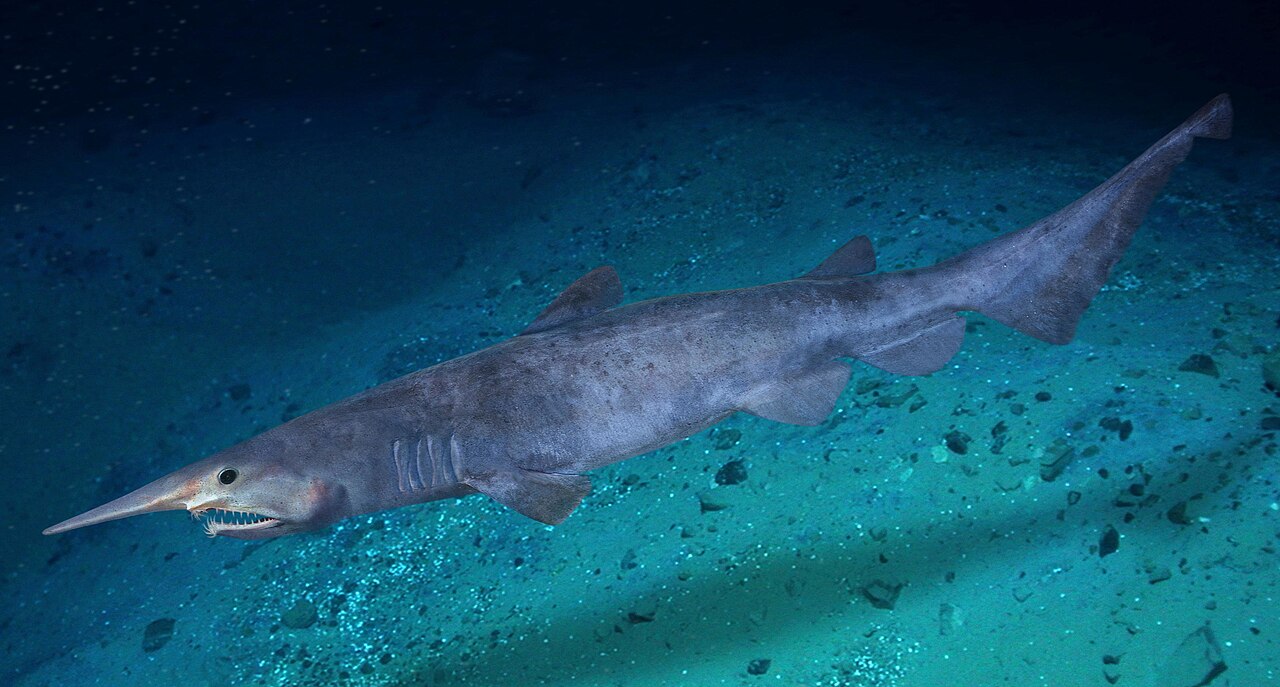
Most sharks bite. The goblin shark launches its whole jaw out of its face like a slingshot. When it strikes, the jaws shoot forward from beneath its long, flat snout, snap shut on prey and retract again. A 2016 study of rare footage found the combined jaw protrusion is 2.1 to 9.5 times greater than in other sharks, with the jaws moving at up to about 3.1 meters per second.
Everything else about the animal is just as odd. Its blade-like snout is packed with electroreceptors called ampullae of Lorenzini, which detect the faint electric fields of hidden prey. Its flabby skin is pink or tan because blood vessels show through it, and the color fades to gray or brown after death. Adults usually measure 3 to 4 meters, though a female caught in 2000 was estimated at 5.4 to 6.2 meters.
American ichthyologist David Starr Jordan described the species in 1898 and named it Mitsukurina owstoni, honoring Yokohama-based collector Alan Owston and Japanese zoologist Kakichi Mitsukuri. Many specimens have come from Japanese waters, but goblin sharks have been recorded in oceans around the world, including the Gulf of Mexico.
1Deep-Sea Anglerfish
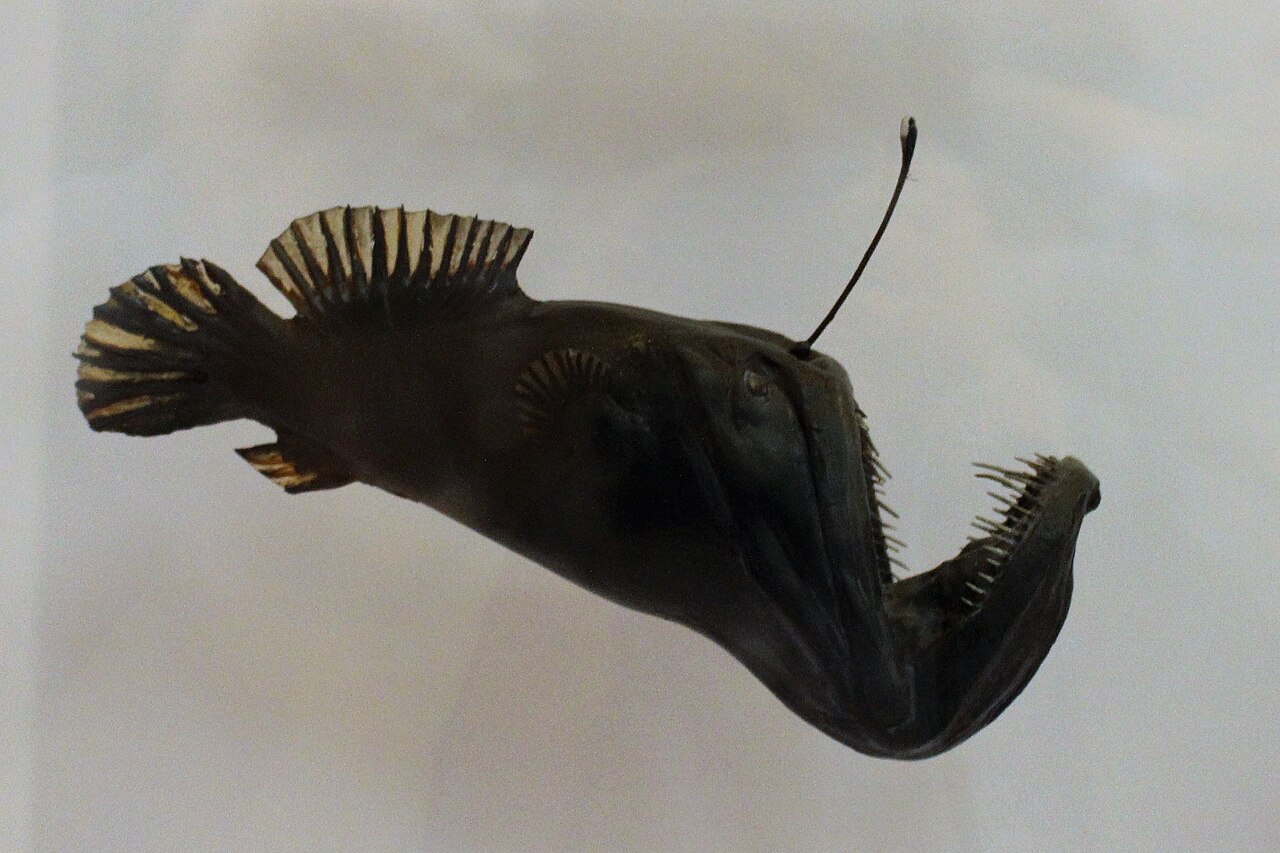
In water so dark that sunlight is a rumor, a small light bobs gently in the black. Anything that swims over for a closer look meets a mouthful of needle-sharp teeth. Female deep-sea anglerfish carry a modified spine on their heads that ends in a fleshy lure called an esca, and it glows thanks to colonies of bioluminescent bacteria living inside it.
Their love life is even stranger. In a habitat this vast and empty, finding a mate is so hard that males in some species bite onto a female and fuse with her permanently, their tissues joining until the male becomes little more than a sperm supplier. Research published in 2020 found that these species have lost key parts of the immune system that would normally reject a foreign body. The size gap can be staggering: mature males of Photocorynus spiniceps measure about 6 to 7 millimeters, while the females are around 5 centimeters.
Few people have seen one alive. In November 2014, a robotic vehicle from the Monterey Bay Aquarium Research Institute filmed a black seadevil, an anglerfish about 9 centimeters long, 600 meters down in Monterey Canyon, likely the first video of the species alive in its habitat. In 2018, explorers Kirsten and Joachim Jakobsen filmed a female fanfin seadevil with an attached male near the Azores.
Down Where the Weird Things Live
Every animal on this list solves the same problems: darkness, cold, crushing pressure and food that might arrive once a week. Some make their own light. Some never stop eating whatever falls from above. Some barely move at all. What looks alien to us is simply what works a kilometer down.
Scientists describe new deep-sea species every year, and much of the seafloor still hasn’t been seen up close. If these creatures left you wanting more, check out these animals with real-life superpowers, or head back to the surface for natural wonders that look like another planet.
Quick answers
Why do deep-sea creatures look so strange?
Deep-sea animals are adapted to an extreme world with no sunlight, near-freezing water, enormous pressure and very little food. That leads to features like glowing lures, oversized mouths and stomachs, jelly-like bodies that save energy, and either huge eyes or almost none. Shapes that look alien to us are practical solutions for surviving in the dark.
What does a blobfish look like underwater?
In its natural habitat 600 to 1,200 meters down, a blobfish looks like a fairly normal fish, with a tadpole-like body and a tapering tail. Its gelatinous flesh holds its shape under high pressure. The droopy, sad face in famous photos is the result of decompression damage when the fish is pulled to the surface too quickly.
How deep is the deep sea?
The deep sea is usually defined as ocean water deeper than about 200 meters, where sunlight becomes too dim for photosynthesis. Below roughly 1,000 meters there is no sunlight at all. The deepest known point, the Challenger Deep in the Pacific’s Mariana Trench, lies nearly 11,000 meters below the surface.
Sources, further reading & photo credits
- Anglerfish — Wikipedia
- Mr Blobby (fish) — Wikipedia
- Scotoplanes — Wikipedia
- Bathynomus giganteus — Wikipedia
- Pelican eel — Wikipedia
- Grimpoteuthis — Wikipedia
- Vampire squid — Wikipedia
- Frilled shark — Wikipedia
- Macropinna — Wikipedia
- Goblin shark — Wikipedia
- Humpback anglerfish — Wikipedia
Cover image: NOAA Okeanos Explorer · Public domain · via Wikimedia Commons. Photos throughout this list are sourced from Wikimedia Commons under the licenses noted in each caption.